If you remain in the international transit area and do not cross passport control, you generally have not crossed the EES external border. If you must enter the country—for example to recheck bags, make a self-transfer or reach a connection that requires passport control—an eligible traveler can be registered in EES at that first border.
Check this connection with the free EES & ETIAS checker →
Select the connection country and whether you stay in the international transit area or cross passport control. No email or passport details needed.
Where does EES happen on a connecting flight?
EES is tied to an external-border crossing, not to the number of flights on your booking. For a traveler covered by EES, the relevant point is the airport where the itinerary first requires entry into the participating area. If you stay in an international transit zone without passing passport control, the layover itself does not usually create an EES entry. If you pass passport control before the next flight, the connecting airport can be the EES point.
The Entry/Exit System has been fully operational at Schengen-area external borders since April 10, 2026. It operates in 25 EU countries, all EU member states except Ireland and Cyprus, and in Norway, Iceland, Switzerland and Liechtenstein. The system electronically records eligible non-EU short-stay travelers' travel-document data, facial image, fingerprints when applicable, and the time and place of the crossing. See the broader 2026 EES border-control guide for the arrival process.
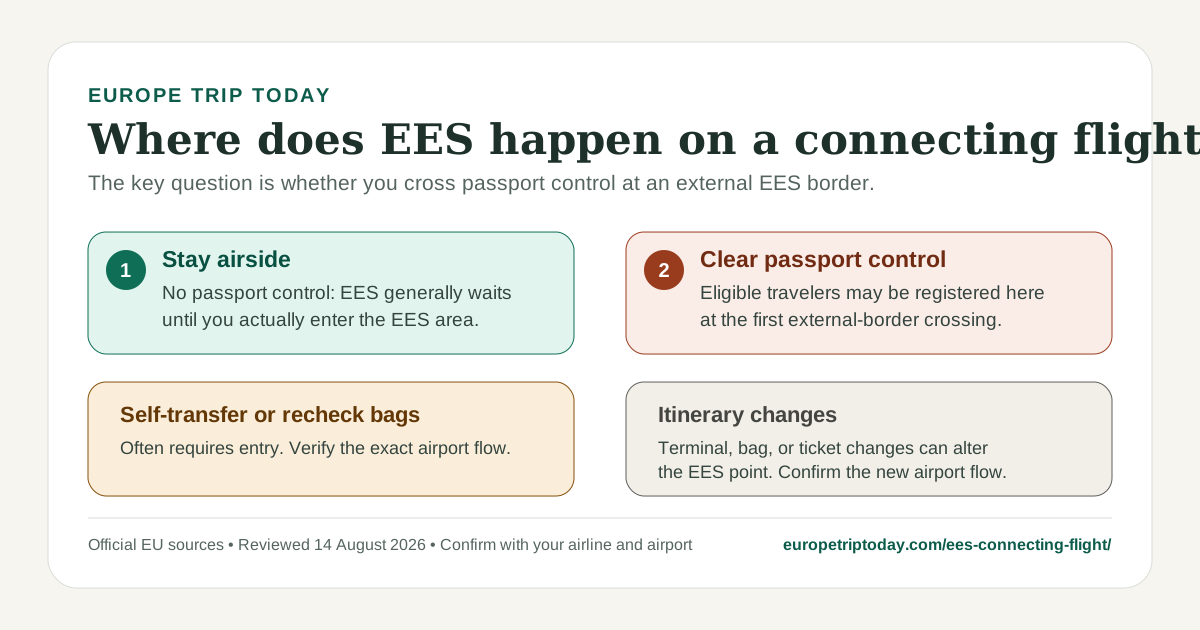
On a small screen, scroll the table sideways to compare all columns.
| Connection clue | Likely passport-control step | What it means for EES |
|---|---|---|
| Stay airside | No passport control is planned. | EES generally waits until you cross an external border into the participating area. |
| Clear passport control | Passport control usually occurs before an internal Schengen flight. | The connecting airport is normally the first EES crossing for an eligible traveler. |
| Self-transfer or recheck bags | Collecting bags or checking in again may require entry. | Do not assume the connection stays airside. Confirm the airport route. |
| Change airport or landside terminal | You must leave the transit area. | You can cross the external border at the connection city before continuing. |
| Itinerary changes | A cancellation, new terminal or baggage issue can alter the route. | Reconfirm with the airline and airport because the EES point may change. |
Citing this guide? Link to this page rather than copying the table without its qualifications and official sources.
Airside transit: when a layover may not involve EES
An airside connection keeps you inside the airport's secure international transit area between flights. You do not present yourself for admission at passport control, so you have not yet crossed that country's external border for EES purposes. A traveler flying from a non-Schengen country through an EES airport to another non-Schengen country may follow this pattern if the airport permits the transfer and the itinerary keeps the traveler airside.
A through ticket and checked-through baggage are useful signs of an airside transfer, but neither is a promise. Some terminal changes require entry. Your nationality may also trigger an airport-transit visa requirement even if EES is not used. Check the airline, airport and official visa guidance.
Connecting to a flight within the Schengen area
If you arrive from outside the Schengen area and connect to a flight treated as an internal Schengen journey, you normally clear passport control at the first Schengen airport. For example, a traveler flying from New York to Rome through Paris would usually pass the external border in Paris before taking the Paris-to-Rome flight. If that traveler is covered by EES, Paris is the relevant registration point. Rome is then the arrival point of an internal flight, not a second external entry.
The same logic works in reverse. On a trip leaving the Schengen area, the exit record is associated with the external-border point where you leave. A connection inside the area may mean the border check occurs at the final Schengen airport on the route rather than where the journey started. Airport procedures and disruption can change the flow, and a border officer remains the final authority at each crossing.
Self-transfers, separate tickets and baggage recheck
A self-transfer often changes an apparently simple layover into a border crossing. Separate tickets can require you to collect checked baggage, enter the arrivals hall, check in with the next airline and pass security again. Baggage reclaim is commonly landside after passport control. If you must enter a country that operates EES, an eligible traveler can be processed there even when the stay lasts only a few hours.
Cabin baggage does not guarantee an airside route. The next airline may require landside check-in, or the terminals may lack an airside connection. Ask whether the airport supports an airside transfer between the exact terminals. Allow time for passport control, baggage, check-in and security. EES does not protect a separately ticketed onward flight.
Terminal changes, missed flights and overnight layovers
A terminal change can stay airside at one airport and require entry at another. Instructions such as “follow Flight Connections” are more useful than terminal numbers alone. If the airport directs you to arrivals, public transport or a landside shuttle, expect a border-control step. An overnight connection also may require entry if the transit area closes or you plan to use a hotel outside the secure zone.
Disruption can change the answer. A missed flight may lead to a different airport or a landside hotel. Follow airline and border-officer instructions, and recheck entry and transit requirements before accepting a reroute.
Ireland and Cyprus connections
Ireland and Cyprus do not operate EES and keep their own border procedures. Manual passport stamping may still apply there. A connection through Dublin or Larnaca therefore does not become an EES crossing merely because the airport is in the European Union. A later entry at a participating Schengen external border can still trigger EES. The reverse is also true: an EES record from an earlier Schengen crossing does not replace Irish or Cypriot checks. Read the Ireland and Cyprus guide when either country appears on the route.
What EES changes at passport control
EES replaces the old reliance on manual passport stamps for covered crossings with an electronic entry and exit record. At the border, the system records travel-document details and biometric information, including a facial image and fingerprints when applicable. The exact sequence can involve a kiosk or other equipment followed by a border officer, depending on the airport's setup and the traveler.
The border officer still decides whether a traveler may cross. EES does not grant entry or replace required visas. The 90 days in any 180-day period short-stay rule continues to apply. An electronic record is not travel permission. More detail is available in the guide to EES and passport stamps.
EES and ETIAS are separate
For airside transit, the official EU ETIAS FAQ says no ETIAS is needed if you only remain in the international transit area. Leaving that area to enter a country requiring ETIAS changes the question once ETIAS operates. This does not waive airport-transit visa rules. Transit and launch status checked September 14, 2026.
ETIAS is a future pre-travel authorization for eligible visa-exempt travelers. It is not operating. The official EU site gives no specific start date and says it will announce the date several months before launch. An airline or airport should not require an ETIAS authorization for travel today before the system begins operating.
EES, by contrast, is already operating at participating external borders. One system records eligible border crossings; the other will concern authorization before travel. Neither replaces the 90/180 rule or a border officer's decision. Compare EES and ETIAS, and check the current ETIAS status for 2026 before relying on dated travel articles.
How to check your exact itinerary
- Identify every border area on the route. Mark flights that arrive from outside Schengen and flights that continue within Schengen. Do not treat “EU” and “Schengen” as interchangeable.
- Ask whether baggage is checked through. Use the booking reference and exact flight numbers. If you must collect and recheck a bag, ask whether reclaim is landside.
- Confirm the transfer path. Check the airport's official connection guide for the arrival and departure terminals. Look for passport control, a landside shuttle or an airport change.
- Check visas separately. Confirm both entry-visa and airport-transit-visa rules for your nationality using official government or EU sources.
- Plan for a changed route. Leave time for border processing, security and check-in. Recheck requirements if the airline reroutes you.
- Use the trip checker as a starting point. The homepage checker can organize the EES and ETIAS questions, but the airline, airport and border authorities control the trip.
Connection FAQ
Do I go through EES on a connecting flight?
You go through EES if you are an eligible traveler and the connection makes you cross an external border of a participating country. A purely airside transfer without passport control generally does not create an entry.
Where does EES happen on a multi-airport trip?
If you enter the EES area, registration normally occurs where you first cross its external border. That may be the connecting airport rather than the city printed as your final destination.
Does an airside connection guarantee no passport control?
No. Terminal layout, baggage handling, ticketing and disruption can change the route. Confirm the exact transfer with the airline and airport.
Does a self-transfer require EES processing?
It can. Collecting baggage, checking in again or moving between landside terminals may require entry. If that entry crosses an EES external border and you are covered by the system, processing can occur there.
Do I use EES when connecting from an international flight to a Schengen flight?
You normally clear the external border before the internal Schengen flight. For an eligible traveler, that first passport-control point is usually where EES records the entry.
Is ETIAS checked during an EES layover?
ETIAS is not operating as of September 7, 2026. It is separate from EES. The official EU site gives no specific start date and says it will announce the date several months before launch.
Official sources
- European Commission: Entry/Exit System
- EU Travel Europe: How EES works at border checks
- EU Travel Europe: Entry/Exit System overview
- EU Travel Europe: ETIAS overview and status
- European Commission: Schengen and airport-transit visa guidance
Last reviewed: September 7, 2026.
Check the rest of your trip
Use the free trip checker for a source-backed EES and ETIAS answer without entering passport details.
Use the free trip checker